Lessons from the Road
Helmet time often produces deep thought. On my motorcycle for 40 days this summer, I had a lot of helmet time. Among other things, I pondered relationships, physics, environmental economics, disease, mortality and the direction I want to take my life.
Fear as a motivator
I thought about the role of fear in our lives and how it seems to motivate people more than anything else. Americans seem to particularly fear failure. Surrounded by crumbling institutions, people are living their lives as if there’s no margin for error.
I almost took my life after a business that I owned failed and took down family and friends financially. A lot of people can relate to that experience, sadly. I’ve drained the dregs of failure’s cup and have decided to move onto a different beverage.
During my 9559 miles of summer I thought about my life’s lessons and how easily I could contextualize them with motorcycling metaphors. Helmet time has that effect on me. Here’s a start:
- Lean in, lean out: Techniques used to control the motorcycle also apply to life
- Everything wobbles: But a wobble doesn’t inevitably lead to a spill
- Blind corners abound: Ride your best ride and take uncertainty as it comes
- Exploit the detours: They’re usually providential
- Embrace the switchbacks: The safest way to the mountaintop isn’t the shortest
Taking those lessons on the road
People are fascinated by motorcycle travel, especially when undertaken by someone who breaks their stereotypes of who’s a biker. In the last year I’ve been asked to speak to business and community groups and been interviewed for newspapers, radio and television. Thanks to helmet time I’ve decided to reach out with the lessons I’ve learned in a more proactive manner, through a book, keynotes and presentations. Here’s who I’m reaching out to:
- Teams getting together to review results or chart a new direction will frame the wobbles, detours and blind corners of the past while mapping a series of switchbacks to the top
- Groups concerned with personal growth will glean takeaways for how to better lean in or out as they navigate through detours, blind corners and switchbacks
- Organizations kicking off a new initiative will accept that wobbles, detours and blind corners are an inevitable part of the journey and that there is no straight path to the pinnacle — only switchbacks
Presentation Tips from a Brain Doctor
While everyone else in my family, and perhaps the country, is obsessed with basketball, I’m enjoying a couple of of PBS shows that only come around during fundraising season. One of them features Dr Daniel Amen, who is a child and adult psychiatrist and brain imaging specialist.
For those who’ve never seen a PBS fundraising program, I’ll just summarize by saying the network offers a variety of shows that they interrupt every 20 minutes or so with requests for funds. The specials vary from arts to documentaries and seminars. Amen falls into the latter category. Take a 30-second look.
Five things to learn about presenting from Dr. Amen
- Use a mantra. Dr. Amen’s is “thinner, smarter, happier.”
- Repeat the mantra. Work the mantra into every section of your talk. Amen will say “on your way to becoming thinner, smarter and happier you’ll also notice…”
- Develop a Star Moment. I learned about Star Moments in Nancy Duarte’s book, Resonate. Amen used a couple of them, but the one that grabbed the most attention was when Amen unveiled two large containers holding 70 pounds of fat, representing the amount of weight one of the audience members had lost on Amen’s program. The audience gasped in repulsion. He picked one of the containers up, noting how difficult it was to carry around. He pointed to them a couple of times later in the talk. As someone who’s carrying the equivalent of one+ of those containers around, that certainly resonated with me.
- Balance light and dark. Amen’s topics included obesity, brain injury, Alzheimer’s, ADHD and other unpleasant subjects, which he leavened with dashes of humor and wit. Tough to pull off, but worth the effort.
Practice until it’s graceful. I wouldn’t have remarked on Amen’s choreography without having turned off a different PBS health seminar a few days earlier because the presenter’s movements were mechanized instead of graceful. The difference between the two programs was the difference between a sixth grader at cotillion and Fred & Ginger. It’s one thing when a colleague’s summary of last quarter’s sales is unpolished, but I expect quality from PBS. Instead, I found myself distracted from the message and picking apart everything the presenter said and did, which was unfair to both of us, but there you have it. I’m fatally human.
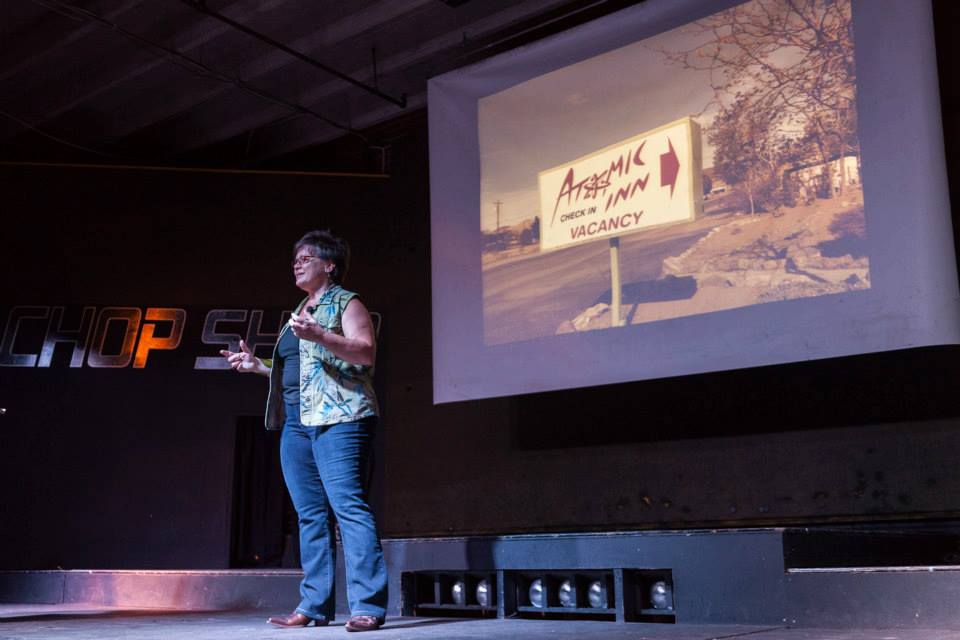
Here’s a presentation I did at the International Motorcycle Show in February. I’m open to all constructive criticism.
“Involve Me, and I Will Understand”
Since I’m an avid BMW motorcyclist now, I came across this video on a forum I belong to.
Don’t dismiss it just because you’ve no interest in motorsports — there’s an important takeaway for professionals who want to connect at a deeper level with clients and prospects.
Involve = Engage
This video underlines the importance of engaging with clients and prospects instead of broadcasting to them. BMW could have splashed its logo on the screen and called it a day, but wasn’t it a better idea to involve the audience? Even to the tiny extent of telling them to close their eyes?
The emotional nature of the message, “Look inside yourself…” and the novelty of the message’s delivery seared the brand into viewers’ memories. Granted, establishing an emotional connection in a novel way is more difficult for a lawyer than for BMW, but it’s being done every day.
Start with key messages that resonate emotionally
What are you selling? It’s not financial planning, accounting services and legal advice. Take it deeper. Is it security? An edge? Peace of mind? Reliability? These are emotion-laden terms, and they resonate where descriptions like financial planning, accounting services and legal advice clank and thunk.
If you can’t distill your key messages to something emotional for your audience, you’ll miss your mark. You’ll waste your time and your money.
Social media involvement
Social media is a natural way to engage clients and prospects. I know business professionals arriving late to the social media party with misguided expectations that a Facebook Page or Twitter account will work for them the way it works for a colleague or competitor who’s been at it for a while. Like everything else in this world, social media produces a yield for those who do their spade work.
Spade work means “involving” yourself in the lives of your prospects and clients by giving away some of your expertise in the course of conversations and interactions. Yes, giving (some of ) it away. And yes, plural conversations and interactions. Social media success isn’t magic — it’s working a strategic plan over a period of time. Spade work.
This is easier to do when you’re producing content – newsletters, blog posts, ebooks, white papers, books, videos, podcasts or presentations. When you’ve stocked your content pantry, it’s easy link that content to someone whose Tweet or status update indicates they need your expertise. Valuable content is a real “follower” magnet, too.
Connecting with audience
Being in front of a captive audience isn’t enough to ensure they’re engaged in your message. Take it a step further. Several months ago I wrote about providing an audience with a note taking guide along with my presentation. Throughout the session I drew their attention to the guide and invited them to share their notes and observations with the rest of the group. This worked on a couple of levels — helping them stay with me and enlisting their fellow audience members to re-enforce my points.
As the video says, “Tell me something and I will forget. Show me something and I can remember. Involve me, and I will understand.” Therefore, in every marketing plan, every communications plan, every pre-conference plan, in every thing, ask how you can involve and engage others in your emotional message.
Case Study: My Social Media Road Trip
I had the opportunity to debrief the Business Sorority of NC on the vital role that social media played in my 2010 road trip. I used Twitter, Facebook Pages, Vimeo, Flickr, and my travel blog to:
raise money for my expenses and the National Breast Cancer Foundation- get news stories in four states during my trip and hours of local coverage
- find co-riders throughout my trip
- earn sponsorships from Caribou Coffee, AAA and BMW
I asked how many of the Business Sorority members used the same tools for their businesses and was surprised how many used Facebook and how few used a blog; here’s the final tally:
- Twitter used by 10%
- Facebook Pages used by 90%
- Video by 5%
- Photos by 0%
- Blog by 30%
The most important social media tool
In the Q&A one woman asked which I felt was the MOST useful/important of these applications. I answered using the Swiss Army Knife example — in social media you’ll use a couple of the tools more than the others, but when you really need that tooth pick/Tweet, you really need it.
For example, when I reached Bend, Oregon (my westernmost destination) I wanted my hometown NBC affiliate to take the feed from the Oregon station and run it in the Charlotte market so I tweeted asking if anyone had a connection to WCNC. Sure enough! While WCNC didn’t get the feed from Oregon, they did three times more than that: they covered my arrival home, featured a live interview with me on their morning show and used footage from my arrival and interviews in a feature story about women motorcyclists.
YEAH, that’s the power of the right tool at the time!
Start with a blog and Facebook page
While YMMV (your mileage may vary) from project to project, I think you’re best served to start with a combination of a blog and Facebook (FB). The blog is your hub and the only asset you truly own. Any of the free online apps can change their terms of service on a moment’s notice, making you vulnerable to losing data or functionality at best and money at worst. For the 90% of Business Sorority members using FB, for example, I asked what would happen if FB decided it was only going to keep the last 3 months of updates? There is no satisfactory answer to the question if you don’t have a blog.
Why Facebook over Twitter? Notwithstanding my success with Twitter, if you’re a beginning social media user, it’s easier to use and a critical mass of most everyone’s friends and business associates are already using it. The key is to place content in your blog FIRST and then link to it from your FB page. That’s not to say you shouldn’t upload videos or pictures to FB, just store them on your blog for safekeeping.
The versatile blog
I use a WordPress theme on my own url (not the free one on the WordPress site). Unlike FB or Twitter, a blog lets me write posts of unlimited length and insert multiple graphics, videos and sound files in each. Facebook allows you to embed ONE thing and with Twitter you can only insert links. I drive traffic to my blog using all the other apps but also send traffic out to those apps via widgets. Take a look at my home page for example, where you can follow my tweets, watch my recent Vimeo videos and connect to my other social media outlets.
If you want to know more, reach out to me or Andy Ciordia, the impresario who makes everything I do online possible.
How to work with a Ghost Writer
People ask me all the time if there’s A WAY to work with a ghostwriter. Chemistry and work preferences vary so I can only answer by describing the way I work with my clients.
Choose a writer who knows YOUR stuff
Before you hire someone to write for you, be sure they have domain expertise. My specialty is business writing and nonfiction because I have the background and education to do the job well. If someone asked me to write for pharma or hi tech I’d have to take a pass — actually I’d have to question why they called me in the first place!
The right relationship starts with due diligence, including work samples and client referrals.
Getting started with a ghost writer
With a bit of ramp up a qualified writer can get to work writing newsletters, blog posts, articles, white papers, presentations, even memoirs in short order. The ramp up includes determining your key messages, perhaps some SEO targets and an editorial calendar. I talk about key messages and an editorial calendar in this video.
Getting YOUR voice out of a ghost writer
If you haven’t yet watched the video above, or stopped it before the end, queue it up to 2:30 where I talk about the advantage of using a sound file when working with a ghost writer.
I find that if clients begin a project by writing it themselves, or responding to my questions in writing, they focus on their spelling and grammar and perhaps their bad typing skills. This means I get less out of them and their project takes longer than if they simply respond to my questions in a natural, conversational way. Any smart phone can serve as a recorder with a downloaded app. If you must buy a recorder, get a Sony with a USB for less than $75.
A voice recording enables me to write for clients in a way that replicates the way they think and express themselves. Of course I clean up grammar, arrange the piece sequentially, dig for case studies and add headlines, tags, illustrations, etc., but the end result is something that sounds familiar to the reader — only better than my client could have produced without my assistance. My clients really do say, “It sounds like me, only better.”
I’m Baaaaaack! Watch Me Tell the Tale
I feel like a kid on the first day of school telling my classmates what I did on my summer vacation!
I think most of my regular readers also follow me on Twitter or Facebook, but for the record, I traveled across 20 states with a pink bra strapped across the windshield of my motorcycle to raise awareness and money for breast cancer research. Along the way I interviewed financial traders for a book I’m co-authoring with Matt Davio called “Tradeoffs: Leveraging the Longs & Shorts of Life.”
Up to speed
The last time I spoke of my trip here I didn’t have a motorcycle and hadn’t completed my training. Happily, I’m now the owner of a BMW G650 GS that carried me 7500 miles across the country without incident!
I posted a series of videos on my travel blog from a breast cancer fundraising event in Charlotte, NC this month. If you watch the entire series you’ll learn the basics: how I prepared, what I saw and did along the way, lessons learned and how advances in treating breast cancer have benefited other cancers. Here’s the first segment; the rest are available on the road trip site.
Let’s talk about the presentation
If you set aside the obvious things like the audience being seated to the side of the screen and other items of ambiance outside my control, my performance illustrates a few things I’ve been preaching about here on the blog for a while.
Zen slide design
Sometimes I have the advantage of working with a talented designer like Andy Ciordia, but when I have to go it alone (which was the case this time), I do my best to employ Garr Reynolds’ advice about structuring and designing a presentation.
Oh, and if you need a speaker for your next event, please think of me. I can talk about my travels, breast cancer, or how I used social media to promote the trip and garner media coverage.
Presentation Note Taking
This morning I co-presented a workshop on social media for real estate agents with Andy Ciordia and Beth Griffiths. The Broker In Charge asked us to provide the presentation in advance so that she could print it out for everyone to take notes on.
This is what people ask you to do because they’re accustomed to death by PowerPoint. In such a death, the speaker lards the presentation with bullet points and basically reads them to the audience (like a first grade teacher at story time).
We don’t subject people to so-called presentations of this ilk.
Our presentations lend visual interest to what’s being said and reinforce the points.
Responding to the request
What did we do? We devised a handout for “guided note taking” that gave our audience questions and prompts to go with the slides. For example, Stop thinking about “creating” traffic. With social media, it’s about “getting in front” of it. What are you doing to use web-based sites and tools to get people to notice you?
Try this technique next time and be sure to wind it down with a solid question like these:
- How many homes would I have to sell each month to pay for this service?
- How many more homes could I list/sell if I were doing this?
In case you’ve never seen this video on the proper use of PowerPoint (or any multimedia during a presentation) be sure to watch it here.
March Book Lust
Big news: I’m writing a book with Matt Davio called Tradeoffs: Leveraging the Longs & Shorts of Life. We’ll use the language and practices of those who trade for a living to frame life’s tradeoffs: time for money, freedom for convention, risk for reward, and money for goods and services.
In a post-meltdown world where so many people feel the stakes are higher and the margin for error more narrow than ever before, Tradeoffs will introduce a general interest reader to how traders view “scalp,” “swing,” “directional,” “fade” or “breakout” trading setups, how they mitigate risk, and how they live with the outcomes of their trades.
We have a book agent who’s excited about the project and will help us get the proposal in tip-top shape by the end of April so he can hit the road with it. Stay tuned!
Trading From Your Gut: How To Use Right Brain Instinct & Left Brain Smarts To Become a Master Trader
by Curtis Faith
Reviewed by Dasan: Legendary trader Richard Dennis believed that trading was so simple that anyone with the right training and psychology could do it successfully. After making millions for himself in the commodity, stock, and FOREX markets, he trained complete novices how to trade in 2 weeks. He called them the “turtles.” He was right – a large number of the “turtles” went on to become very successful traders in their own right. Curtis Faith, the author of this book, was one of best of the turtles.
In “Trading From Your Gut” Curtis Faith’s discusses a central aspect of trading success: Intuition. While most mediocre traders let emotions drive their trading, better traders use primarily rational thought. The best traders of all, the master traders, use a balance of intuition and rational thought. Like the experienced poker player that just knows what the other player has, these master traders can identify trend reversals simply by “gut feel” which comes from a combination of experience and underlying rational thought.
This is an excellent book for the intermediate level investor. The author does give a basic explanation of a rudimentary swing trade system, but it is just enough knowledge to be dangerous. I would not recommend this book for a rank novice. However, if you have some experience trading stocks or commodities already, this book is extremely valuable. For me as an experienced hedge fund investor, I found his concepts mainly affirmed in a concise way what has taken me years to learn. In this way, this book could make a moderately experienced trader more successful very quickly.
The main thesis of the book is the importance of intuition in trading, especially by experienced traders who already have mastered their emotions. He says it like this: “A balance between left-brain analysis and right-brain intuition is critical for optimal trading.” He quotes many experts in this book, which adds a lot of value; for example, he quotes Barry Ritholz’s idea that “wisdom is the capability to have `strong opinions, weakly held.’” Faith emphasizes the importance for a master trader to think independently. He writes “If you want to be a master trader, you need to develop your own reasons for making trades.” He illustrates the concept of waiting for the right trade by comparing it to surfing at the beach, waiting for the right wave. The book is full of detailed examples like this, which illustrate his trading concepts. Faith wraps up the book with a discussion on ways to limit risk by being flexible, having a plan “B” and sizing positions properly to avoid overcommitment of your capital.
This book is valuable to any serious trader or investor looking to raise the level of their game. Novice investors have other volumes to read first.
Here’s my co-author Matt interviewing author Curtis Faith:
The Back Channel: How Audiences are Using Twitter and Social Media and Changing Presentations Forever
by Cliff Atkinson
Reviewed by yours truly: This book caught my eye because it grasped a phenomenon I’ve observed at events where the audience gives more eyeball time to their netbooks and smart phones than to the presenter. I figured someday I’d figure out how to harness the power of this behavior, and author Cliff Atkinson beat me to it. Mr Atkinson is THE authority to write on the matter. In addition to writing Beyond Bullet Points, he designed the presentations that helped persuade a jury to award a $253 million verdict in the nation’s first Vioxx trial in 2005. Fortune magazine called the presentations “frighteningly powerful.”
For those new to the back channel and the ways of Twitter, never fear. The book starts there, not with boring exposition, but with a real-life event where panelist Guy Kawasaki noticed a critical tweet (Twitter update) about him and asked the tweep (person who tweeted) to step up and explain the remark. After setting the context for Twitter and the back channel with this case study, Mr Atkinson goes into the mechanics of Twitter and other technological means for sustaining an official back channel.
The part of the book that everyone presenting can use (with or without a back channel) describes how to be an editor, curator and taste-maker to your audience. Thinking of yourself in these ways makes it 100% easier to craft a presentation.
Mr Atkinson outlines a strategy for JOINING the back channel’s conversation, including how to manage a “conversational presentation.” Presenters with and without a back channel should follow this advice
You can no longer get away with putting up a slide that lists Agenda or Introduction at the start of your presentation. Nor can you get away with kicking off your presentation with too many details or a list of your accomplishments. In a world in which your audience is accustomed to high-quality media at their fingertips, you need to capture their attention out of the gate. You must engage your audience within the first five slides or at least the first five minutes of your presentation.
The book offers a chapter on how to handle the positive and negative feedback from the back channel. Particularly helpful is the advice that speakers should practice scenarios that put them in a range of difficult situations. He gives five scenarios to practice: “You’re not listening to us;” Your Facts are wrong or misleading;” “Your material is a mismatch for us;” “Your material is boring;” and “You made me mad.”
Finally, relying on an excellent case study from a conference gone snarky via the backchannel, Mr Atkinson shows how Chris Brogan (author of Trust Agents) turned the situation around. Here’s the 10-point checklist for managing an unruly back channel:
- Establish a reputation
- Listen and collect stories
- Dispense with pretense
- Talk to the elephant in the room (if there is one)
- Make it you, you, you instead of me, me, me
- Check in with the audience early and often
- Improvise
- Stay grounded
- Ignore the small stuff
- Keep things in perspective
This slim volume is worth the $34.99 list price and includes a free 45-day searchable online edition. Both of my thumbs are way up.
Why We Make Mistakes: How we look without seeing, forget things in seconds, and are all pretty sure we are way above average
by Joseph T. Hallinan
Publishers Weekly review: Pulitzer winner for his stories on Indiana’s medical malpractice system, Hallinan has made himself an expert on the snafus of human psychology and perception used regularly (by politicians, marketers, and our own subconscious) to confuse, misinform, manipulate and equivocate. In breezy chapters, Hallinan examines 13 pitfalls that make us vulnerable to mistakes: “we look but don’t always see,” “we like things tidy” and “we don’t constrain ourselves” among them. Each chapter takes on a different drawback, packing in an impressive range of intriguing and practical real-world examples; the chapter on overconfidence looks at horse-racing handicappers, Warren Buffet’s worst deal and the secret weapon of credit card companies. He also looks at the serious consequences of multitasking and data overload on what is at best a two- or three-track mind, from deciding the best course of cancer treatment to ignoring the real factors of our unhappiness (often by focusing on minor but more easily understood details). Quizzes and puzzles give readers a sense of their own capacity for self-deception and/or delusion. A lesson in humility as much as human behavior, Hallinan’s study should help readers understand their limitations and how to work with them.
Genius on the Edge : The Bizarre Double Life of Dr. William Stewart Halsted
by Gerald Imber
Intro to a Fresh Air interview with the author: In the second half of the 19th century, New York City’s population swelled from several hundred thousand to just over 2 million people. Conditions were not pleasant: Sewers were virtually nonexistent; piles of manure sat several inches high on sidewalks; and the city was overrun by disease.
Medical practices of the time were crude, at best: If surgical procedures were performed, they were done without sterilizing the equipment or the operating room, and typically ended with the patient losing an entire limb, if not his life.
It was in this environment that Dr. William Halsted began his surgical career. Halsted, who began the nation’s first residency program, pioneered techniques ranging from blood transfusions to sterilizing operating rooms. He also developed the radical mastectomy — also known as the Halsted mastectomy — reducing the local recurrence of breast cancer in patients nearly 50 percent. When Johns Hopkins Hospital opened its Department of Surgery in 1889, Halsted was named its first supervisor.
Though his legacy suggests a medical pioneer who made surgery safer and more precise, Halsted’s life was frequently messy.
That dual life is examined in Gerald Imber’s new biography of the doctor, Genius on the Edge: The Bizarre Double Life of Dr. William Stewart Halsted.
Imber traces Halsted’s journey from a young Columbia-trained medical student to a successful surgeon who secretly suffered from several narcotic addictions. Imber, himself a plastic surgeon, says that while Halsted was a “rigid perfectionist in some portions of his life, [he was] totally negligent and forgetful in others. He could leave a patient in a hospital bed for weeks on end and forget to operate on them.”
Imber talks to Fresh Air about Halsted’s dual lives and about 19th century American medicine. Imber is an internationally known plastic surgeon who specializes in facial rejuvenation and noninvasive surgical techniques.
Please tell me if you have a book to recommend or review for April’s post.
Nuke the Bullets!
Great advice in this video on SUPPORTING your talk with a presentation (Powerpoint, Keynote, etc), not leaning on it.
Low-Jargon Financial Blogs & Newsletters
I write blogs and newsletters for attorneys, advisors and accountants. These professionals often need to provide complex information without making their clients’ eyes glaze over.
Professionals with compliance/malpractice concerns too often navigate the middle of the road where nothing meaningful is communicated. Some admit they hope readers will pick up the phone and call for clarification “on the clock.” Bad strategy.
Everyone faces this challenge of writing thorough-yet-understandable communications from time to time. Here are writing tips for newsletter or blog writers who aspire to communicate without using jargon on one hand, or dumbing down the message on the other.
It’s a conversation, not a treatise
- Provide links to jargon, technical definitions and 50-cent SAT words like “treatise.” This way, everyone can get as much info as they need on their own and your writing doesn’t bog down
- Don’t mistake your articles for term papers!
- Use headers, bolds and links to enable (gasp) skimming
- Avoid passive voice; use active voice
- Write to the appropriate reading level of your audience
- Run your copy through a fog index calculator (tells the number of years of education needed to understand what you’ve written)
- If you use Google Docs, click Tools>Word Count and find the analysis at the bottom
- You’re not a professor
- Don’t try to tell everything you know about the subject. Pare it down to the essentials
- For weighty topics, write a series of short articles
- Provide an intro to the topic in your newsletter and link to your blog/elsewhere for details. If you can find a video (or make one yourself) your audience will be grateful. Here’s how one of my clients does it
- Leverage industry videos and handouts (be sure to comply with licensing and copyrights)
Engage readers
- Invite them to leave comments and comment on those of others
- Offer a free worksheet to help them apply the information to their lives — invite them to review the information with you off the clock, if appropriate
- Ask readers to weigh in on a topic by linking to a survey that gives them the option to see how their answers compare to those of other respondents
- Poll readers for future articles on similar/related subjects
Brains need variety
-
Use stories – our brains are wired for stories -and people “find” themselves in them.
-
Use case studies for the same reasons
-
Link to a narrated presentation deck or video to stimulate the story-receptive part of readers’ brains. One of my clients does this very well
-
Use infographics or produce your own charts and tables. FlowingData is a great resource to learn about them and you might find one to use there
What techniques have you or others used to make complex information digestible? What have you seen out there that turns you off?