Tamela Rich

Presentation Tips from a Brain Doctor

While everyone else in my family, and perhaps the country, is obsessed with basketball, I’m enjoying a couple of of PBS shows that only come around during fundraising season. One of them features Dr Daniel Amen,  who is a child and adult psychiatrist and  brain imaging specialist.

For those who’ve never seen a PBS fundraising program, I’ll just summarize by saying the network offers a variety of shows that they interrupt every 20 minutes or so with requests for funds. The specials vary from arts to documentaries and seminars. Amen falls into the latter category. Take a 30-second look.


Five things to learn about presenting from Dr. Amen

  1. Use a mantra. Dr. Amen’s is “thinner, smarter, happier.”
  2. Repeat the mantra. Work the mantra into every section of your talk.  Amen will say “on your way to becoming thinner, smarter and happier you’ll also notice…”
  3. Develop a Star Moment. I learned about Star Moments in Nancy Duarte’s book, Resonate.  Amen used a couple of them, but the one that grabbed the most attention was when Amen unveiled two large containers holding 70 pounds of fat, representing the amount of weight one of the audience members had lost on Amen’s program. The audience gasped in repulsion.  He picked one of the containers up, noting how difficult it was to carry around. He pointed to them a couple of times later in the talk. As someone who’s carrying the equivalent of one+ of those containers around, that certainly resonated with me.
  4. Balance light and dark. Amen’s topics included obesity, brain injury, Alzheimer’s, ADHD and other unpleasant subjects, which he leavened with dashes of humor and wit. Tough to pull off, but worth the effort.
  5. Practice until it’s graceful. I wouldn’t have remarked on Amen’s choreography without having turned off a different PBS health seminar a few days earlier because the presenter’s movements were mechanized instead of graceful.  The difference between the two programs was the difference between a sixth grader at cotillion and Fred & Ginger. It’s one thing when a colleague’s summary of last quarter’s sales is unpolished, but I expect quality from PBS. Instead, I found myself distracted from the message and picking apart everything the presenter said and did, which was unfair to both of us, but there you have it. I’m fatally human.

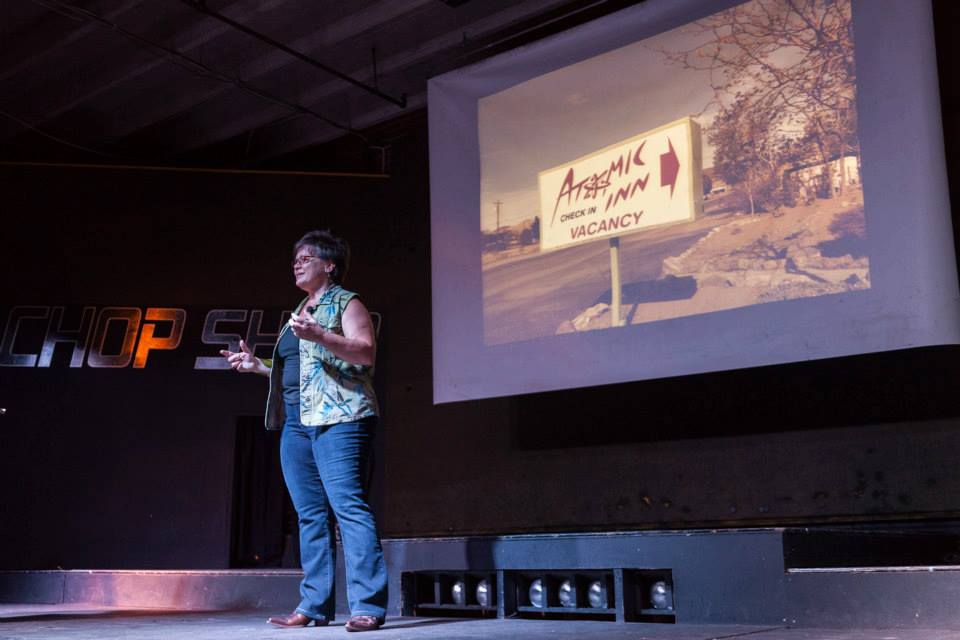
Here’s a presentation I did at the International Motorcycle Show in February. I’m open to all constructive criticism.

I’m Baaaaaack! Watch Me Tell the Tale

I feel like a kid on the first day of school telling my classmates what I did on my summer vacation!

I think most of my regular readers also follow me on Twitter or Facebook, but for the record, I traveled across 20 states with a pink bra strapped across the windshield of my motorcycle to raise awareness and money for breast cancer research.  Along the way I interviewed financial traders for a book I’m co-authoring with Matt Davio called “Tradeoffs: Leveraging the Longs & Shorts of Life.”

Up to speed

The last time I spoke of my trip here I didn’t have a motorcycle and hadn’t completed my training. Happily, I’m now the owner of a BMW G650 GS that carried me 7500 miles across the country without incident!

I posted a series of videos on my travel blog from a breast cancer fundraising event in Charlotte, NC this month.  If you watch the entire series you’ll learn the basics: how I prepared, what I saw and did along the way, lessons learned and how advances in treating breast cancer have benefited other cancers.  Here’s the first segment; the rest are available on the road trip site.

Let’s talk about the presentation

If you set aside the obvious things like the audience being seated to the side of the screen and other items of ambiance outside my control,  my performance illustrates a few things I’ve been preaching about here on the blog for a while.

  • I didn’t READ to the audience
  • My slides were short on text
  • I used pictures to support what I was saying
  • Lacking a remote, I used a visual cue (changing my note cards) so my assistant could keep pace without distracting the audience
  • The slides changed every minute or so for a refreshing visual pace

  • Zen slide design

    Sometimes I have the advantage of working with a talented designer like Andy Ciordia, but when I have to go it alone (which was the case this time), I do my best to employ Garr Reynolds’ advice about structuring and designing a presentation.

    Oh, and if you need a speaker for your next event, please think of me. I can talk about my travels, breast cancer, or how I used social media to promote the trip and garner media coverage.

    Social Media: Ethics & Best Practices for Attorneys

    Like financial professionals, attorneys bear the burden of using good sense and propriety online.  Would that everyone bore a similar burden! (but I digress).

    Friday morning I co-facilitated a continuing education seminar for the Mecklenburg County Bar on social media with Andy Ciordia and Ted Claypoole . The attorneys asked great questions and the three of us presenting enjoyed the lively discussion.

    Peppering his ethics guidance with jaw-dropping anecdotes of ethical lapses by legal professionals, Ted boiled everything down to four categories of concern:

    • Talking too loosely
    • Improper investigation (pretexting)
    • Sites that don’t provide room for proper disclaimers (think: Twitter)
    • Advertising Rules

    I’m unqualified to say anything about legal ethics, but from a middle-aged lay person’s vantage point,  much of what Ted said seemed like common sense and good manners: don’t say anything about someone behind their back that you wouldn’t say to their face; don’t misrepresent yourself or your behavior; and don’t tell a judge you need a continuance because your father died if your Facebook page shows you were getting smashed at your college roommate’s wedding!

    Advice for blogging, Facebook and Twitter

    Andy and I showed several examples of what to do and not to do on the big three social media platforms:

    Blogging: We didn’t need to dwell on the oft-repeated advice to publish frequently — they’d all heard it.  We took it further to show how you can subscribe to content feeds to supplement your own articles but also warned to keep non-pertinent content off your site. We showed an example of an otherwise-good blogsite by a divorce lawyer who inexplicably featured an article on SEO and Google.

    Huh? Stick to your knitting.

    Facebook: We see lots of lawyers using their personal FB profile as a professional site. Some even call it “The Family Law Firm of Jane Doe” or similar appellations — a big no-no and a violation of FB’s terms of service. FB created “Pages” for commercial use.  Go to my AUTHOR PAGE of FB and you’ll see how it differs from the personal.

    Other observations: Some lawyers don’t engage the public in discussions, only BROADCAST their blog posts and speaking events. Still others don’t moderate the spam that users place on their pages. In one page we showed a firm that didn’t remove vulgarities and insults. It’s YOUR page, YOU decide what stays and goes. If you don’t tend to your social media outposts, clients might ask how closely you pay attention to the other details of your practice (including their work).

    Twitter: The main concern Andy and I expressed here is lack of engagement. Most of what we saw lawyers do is BROADCAST new blog posts or news of the firm. Blech. If you’re not engaging people on Twitter, don’t waste your time with it.

    If you’re unsure where to take your social media marketing efforts, reach out. If I don’t have the answers, Andy or Ted will.

    Presentation Note Taking

    Presentation Secrets of S JobsThis morning I co-presented a workshop on social media for real estate agents with Andy Ciordia and Beth Griffiths.  The Broker In Charge asked us to provide the presentation in advance so that she could print it out for everyone to  take notes on.

    This is what people ask you to do because they’re accustomed to death by PowerPoint. In such a death, the speaker lards the presentation with bullet points and basically reads them to the audience (like a first grade teacher at story time).

    We don’t subject people to so-called presentations of this ilk.

    Our presentations lend visual interest to what’s being said and reinforce the points.

    Responding to the request

    What did we do? We devised a handout for “guided note taking” that gave our audience questions and prompts to go with the slides.  For example, Stop thinking about “creating” traffic. With social media, it’s about “getting in front” of it. What are you doing to use web-based sites and tools to get people to notice you?

    Try this technique next time and be sure to wind it down with a solid question like these:

    • How many homes would I have to sell each month to pay for this service?
    • How many more homes could I list/sell if I were doing this?

    In case you’ve never seen this video on the proper use of PowerPoint (or any multimedia during a presentation) be sure to watch it here.

    Nuke the Bullets!

    Great advice in this video on SUPPORTING your talk with a presentation (Powerpoint, Keynote, etc), not leaning on it.

    Brains Need Stories

    Presentation Secrets of S Jobs

    Evidently story-loving is a function of our brain’s development. We’re biologically wired for them.

    In a Washington Post story I learned: “Roughly around age 4, psychologists say, a child develops a ‘theory of mind.’ The child suddenly grasps that other people have feelings, thoughts, just like the child’s own. From this great mental leap comes a secondary, almost accidental talent: We can get inside the heads of people whom we never actually meet except in stories. This is why fiction works. Huck Finn and Harry Potter seem real enough.”

    Is this why Steve Jobs is the world’s greatest keynoter? Because he’s a great storyteller? In the new book The Presentation Secrets of Steve Jobs we learn his three-act methodology:

    • Act1 is to create a story with seven tips (chapters or scenes) in crafting a great story behind the presentation
    • Act 2, delivery of an experience with six scenes for adding appealing visuals to a presentation.
    • Act 3, refine and rehearse and rehearse some more with five scenes discussing body language, verbal delivery, and using appropriate dress

    I wrote a post on PowerPoint and effective presentations a couple of months ago that got excellent traction with readers. Join the discussion.

    Prompts for Professionals

    Next time you’re trying to deliver a memorable presentation try:

    “I loved the way he used PowerPoint”

    Real Leaders Don't Use PowerPointThe anti-PPT bandwagon doesn’t have room for another rider. My only addition to the chorus  is that a bad PPT-based presentation is like a bad dog — blame the owner!

    PPT isn’t inherently bad, but, like a Rotweiller, can be placed in the wrong hands and do real damage.

    I generally agree with the authors of Real Leaders Don’t do PowerPoint: How to sell yourself and your ideas, “You are the message. Who you are–your character, experience, values–shapes the message your listeners hear.”

    Dan Ariely, PowerPoint master

    Ariely & MePredictably IrrationalLast year I heard Dan Ariely, bestselling author and professor at my B-school (Fuqua — Duke) speak on behavioral economics and his first book Predictably Irrational.

    In staccato diction, he regaled us with tales of our irrational behavior — like why we won’t pay $3000 for a leather couch in the family room while we will pay the same amount for a leather interior in our family car — and he did it with the delivery skills of any comedian’s aspiration.

    If he’d been a rock star we’d have whipped out our cigarette lighters and stomped our  feet until he gave an encore.

    And yes, he used PPT, including a slide with an x-ray of Homer Simpson’s brain.  See?  I remembered that one.

    In defense of PowerPoint

    Recall a time when someone gave a terrific, memorable, actionable presentation WITH PPT, as Professor Ariely did.

    I’ll wait.

    OK, I can’t wait all day.

    If you did have the good fortune of attending such an event, you’ll recall that PPT didn’t make it great — it was great because the speaker had something to say and said it with conviction; they knew their stuff cold, engaged the audience, told stories and stayed ON POINT.  Did the PPT help?  Maybe, after all, who knows how it would have gone without the screen?

    Reasons for PPT:

    • Leave-behind for those who couldn’t make it to the live event
    • Guided handout for taking notes
    • Satisfies the need for visual stimulation
    • Illustrate points graphically

    Bottom line:  No one says “I loved the way he used PowerPoint;” but if you’re a good presenter they’ll say “I’d go see him speak again.”

    Malcolm Gladwell speaks

    Blink by Malcolm GladwellA friend of mine had the good fortune of attending The Foundation for the Carolinas’ annual meeting.  You can hardly drag me to one of those, but I wish I’d gone to this one.  Why?  Bestselling author and New Yorker writer Malcolm Gladwell did the keynote.

    According to my friend, Gladwell took a wireless mike and roved the audience, telling stories about a town in (I believe) Pennsylvania and how and why it prospered and failed.  My friend, a public relations pro who is not easily impressed, was awed.

    Just the opposite of Ariely, Gladwell is soft spoken.  Where Ariely is irreverent, Gladwell is earnest.  Both can bring the house down.

    I’m not a qualified speaking coach — my specialty is the content — but to me this is the bottom line:  You don’t have to be “dynamic” to get your message across.  The book mentioned earlier, Real Leaders Don’t do PowerPoint: How to sell yourself and your ideas, got good reviews and the website and book Presentation Zen is chock full of great stuff. And I’m always here to help.

    It’s easy to bash PPT, and you’re welcome to bash away in the comments section.  I’d really like to hear from you about a presentation that thrived WITH the visual support.

    Beware the Fart Joke

    We are a collection of "selves"

    We are a collection of "selves"

    Catching up on reading this week at the beach, including past issues of my favorite magazine, The Atlantic.

    The November 2008 edition carried a fascinating article that touched on neuroeconomics, or the neurophysiology of economic decisions. I love this stuff.

    According to Yale professor of psychology, Paul Bloom, “…remembering something is easiest while you are in the same state in which you originally experienced it. Students do better when they are tested in the room in which they learned the material; someone who learned something while he was angry is better at remembering that information when he is angry again; the experience of one’s drunken self is more accessible to the drunk self than to the sober self. What happens in Vegas stays in Vegas.”

    Bloom’s research underscores why effective business communications need to take people to an emotional place in order to cement the message. Warren Buffett did this well in his 2009 annual letter to shareholders when he drew a parallel between derivatives and venereal disease:  “Participants seeking to dodge troubles face the same problem as someone seeking to avoid venereal disease: It’s not just whom you sleep with, but also whom they are sleeping with.”

    If that gives you a creepy feeling, the Oracle from Omaha met his objective; he hates derivatives.

    More Buffett bon mots:

    • Tony and I feel like two hungry mosquitoes in a nudist camp. Juicy targets are everywhere.
    • By year end 2007, the half dozen or so companies that had been the major players in this business had all fallen into big trouble. The cause of their problems was captured long ago by Mae West: “I was Snow White,but I drifted.”
    • If merely looking up past financial data would tell you what the future holds,the Forbes 400 would consist of librarians.
    • The tennis crowd would call my mistakes “unforced errors.”
    • Upon leaving, our feelings about the business mirrored a line in a country song: “I liked you better before I got to know you so well.”
    • Investors should be skeptical of history-based models. Constructed by a nerdy-sounding priesthood using esoteric terms such as beta, gamma, sigma and the like, these models tend to look impressive. Too often, though, investors forget to examine the assumptions behind the symbols. Our advice: Beware of geeks bearing formulas.

    Advice for speakers

    Back to Paul Bloom in The Atlantic story,  “Good smells, such as fresh bread, make people kinder and more likely to help a stranger; bad smells, like farts (the experimenters used fart spray from a novelty store), make people more judgmental. If you ask people to unscramble sentences, they tend to be more polite, minutes later, if the sentences contain positive words like honor rather than negative words like bluntly. .. All of these studies support the view that each of us contains many selves-some violent, some submissive, some thoughtful-and that different selves can be brought to the fore by different situations.

    Next time you’re delivering a presentation, keep this in mind.  The oft-repeated advice to open with a joke should be tempered by what you just learned about neurophysiology — don’t make it a fart joke.

    Smelling your Content

    According to Dr. John Medina, “Smell is unusually effective at evoking memory. If you’re tested on the details of a movie while the smell of popcorn is wafted into the air, you’ll remember 10-50% more.”

    Book by BY LYALL WATSON

    Book by BY LYALL WATSON

    Makes you rethink the food and beverages you offer at presentations, doesn’t it?

    And how about doing reconnaissance on the meeting room itself? Giving a presentation in a stinky room might associate you with “stinky” content.

    That said, kicking the sales team in the pants while they whiff the cafeteria’s burnt offerings might subliminally reinforce your point to get going or get burned.

    But before you break out the room freshener, do some research.  Men and women prefer different smells and certain smells perk us up while others have a sedating effect.


    The Ten-Minute Window

    DR. JOHN J. MEDINA is a developmental molecular biologist focused on the genes involved in human brain development and the genetics of psychiatric disorders.

    Stay with me.

    He also runs a site and authored a book entitled  “Brain Rules” in which he expounds upon “12 rules for surviving and thriving at work, home and school.”

    Medina’s Rule #4 says “We don’t pay attention to boring things.”

    Today’s blog focus, presentations.

    Thousands of cartoons

    Thousands of cartoons

    Since presentations (and their presenters) are too often boring, we don’t pay attention to them — sometimes to our detriment.  Medina shows that every ten minutes or so our attention flags and we need a little shot of something to continue paying attention. He says this little shot should be ” emotionally relevant.”

    Consider the occasional New Yorker cartoon.  For $20 each, you can insert a witty and apropos cartoon into your deck and keep your group’s attention.  Plus that, you’ll look urbane and well-read.


    Tamela Rich
    show